
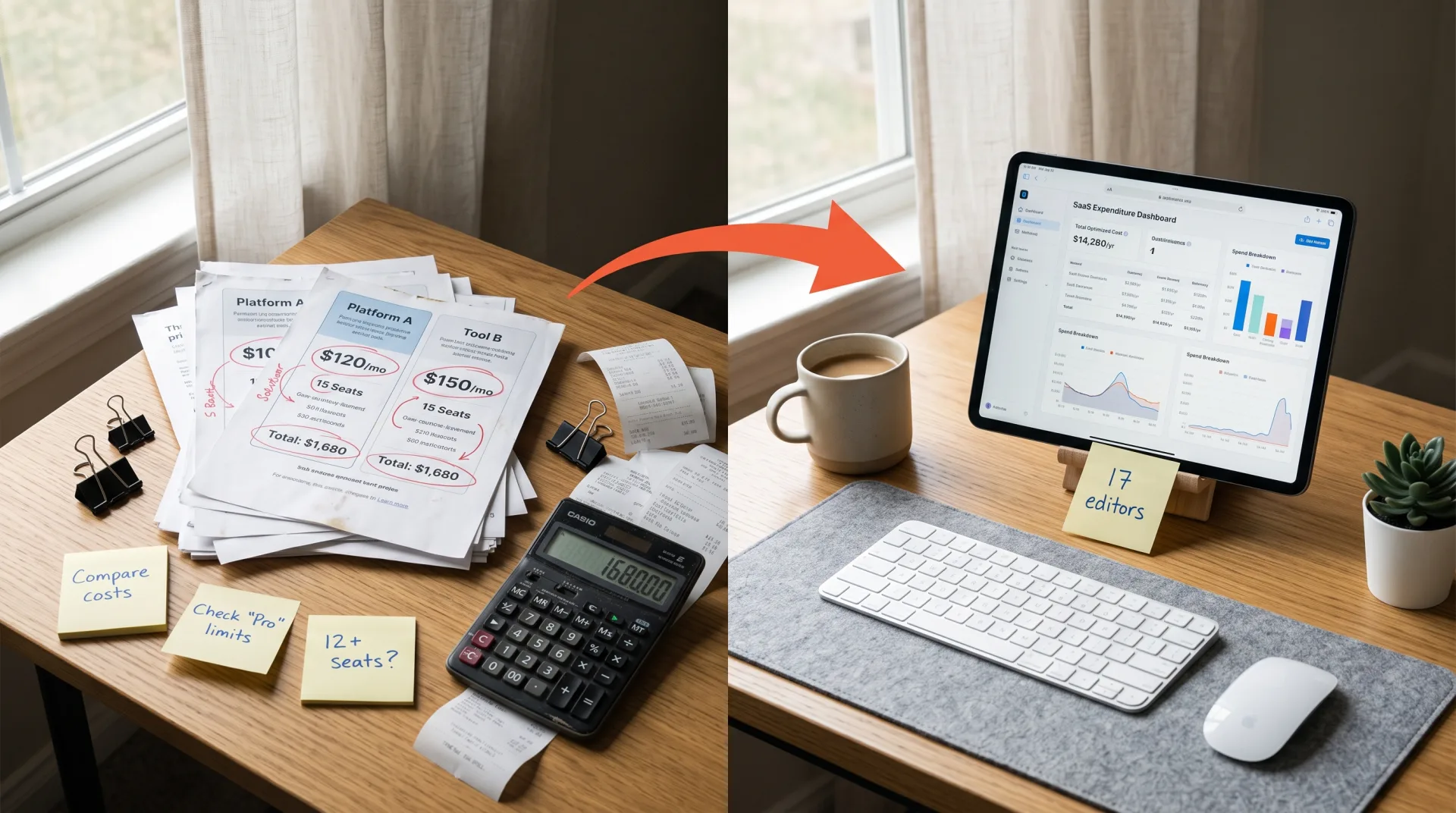
Building your own internal tool starts to beat paying for Airtable seats at about 17 editors. Below that line the seat is cheaper. Airtable Team costs $20 per user per month on annual billing (Airtable, retrieved 26 September 2026), which is $720 per editor over 36 months. Our base build scenario costs $11,856.96 over the same period: 40 hours to build and 4 hours a month of upkeep, priced at $64.44 an hour, the 2025 US median pay for software developers, quality assurance analysts and testers (US Bureau of Labor Statistics).
Maintenance is $9,279.36 of that total, 3.6 times the build itself. Double the upkeep to 8 hours a month and the crossover moves out to about 30 editors.
On 26 September 2026 every page-one result for "build vs buy internal tools" came from a company that sells building, Retool and ToolJet among them. None totals seats over several years or cites a team that went back to a bought tool. This post does both and says plainly that buying the seat is often right.
This is a spoke of Own Your Stack, our operator's manifesto. The six-variable build-versus-buy matrix lives in the SaaS replacement playbook; this post adds the seat arithmetic and failure evidence.
By Dan Colta. NodeSparks is a two-person EU automation studio that replaces SaaS subscriptions and automates operations for SME teams. We get paid to build, which is worth remembering in a post that mostly tells you to buy.
Key Takeaways
- Airtable Team at $20 per editor (Airtable) costs $3,600 at 5 editors, $10,800 at 15 and $36,000 at 50 over 36 months, by our arithmetic. Read-only collaborators are free.
- Our build scenario costs $11,856.96 over 36 months at the $64.44 BLS median wage (BLS) plus EUR 197.64 of hosting (Hetzner).
- Building crosses Airtable Team at about 17 editors with 4 hours of monthly upkeep and at about 30 with 8. It never crosses Softr's bundle pricing within 50 users (Softr).
- The documented failure mode is maintenance. One team returned to Linear about four and a half months after building its own Jira replacement, per a second-hand account on X (Neha Kalani).
- At 5 seats, buy. Retool Free costs EUR 0 for up to 5 users (Retool).
What does an internal tool seat cost over 36 months?
Anywhere from EUR 0 to $97,200, depending on the product, the plan and who counts as a seat. Airtable Team at $20 per editor on annual billing (Airtable) comes to $3,600 at 5 editors, $10,800 at 15 and $36,000 at 50. Retool Free costs EUR 0 for a team of up to 5 users (Retool).
| Product and plan | Pricing unit | 5 seats | 15 seats | 50 seats |
|---|---|---|---|---|
| Airtable Team, annual | $20 per editor | $3,600 | $10,800 | $36,000 |
| Airtable Team, monthly | $24 per editor | $4,320 | $12,960 | $43,200 |
| Airtable Business, annual | $45 per editor | $8,100 | $24,300 | $81,000 |
| Airtable Business, monthly | $54 per editor | $9,720 | $29,160 | $97,200 |
| Retool Free | Up to 5 users | EUR 0 | Over the cap | Over the cap |
| Retool Team, annual | EUR 9 per builder, EUR 5 per internal user | EUR 1,044 | EUR 2,988 | EUR 9,720 |
| Retool Business, annual | EUR 46 per builder, EUR 14 per internal user | EUR 3,672 | EUR 9,864 | EUR 30,960 |
| Softr, annual | Workspace bundle, $3 per extra Team user on Pro | $684 (Basic) | $4,104 (Pro) | $7,884 (Pro) |
| monday.com Standard, annual | EUR 12 per seat | EUR 2,160 | EUR 6,480 | EUR 21,600 |
| monday.com Pro, annual | EUR 19 per seat | EUR 3,420 | EUR 10,260 | EUR 34,200 |
| Appsmith cloud Business | $15 per user | $2,700 | $8,100 | $27,000 |
| Glide Pro | $125 a month from 5 members | $4,500 | No public price | No public price |
36-month totals, our arithmetic, in the currency each pricing page showed us on 26 September 2026. Nothing is converted. Retool assumes 1 builder at 5 seats, 2 at 15 and 5 at 50. Softr's 15-seat and 50-seat cells are Pro plus $3 for each Team user past the 10 included.
Retool and monday.com showed euros to our EU connection (monday.com). Airtable's monthly prices come from its plans documentation (Airtable Support). Softr's come from its own help docs (Softr), which third-party listings contradict. Glide lists Pro at $125 a month starting at 5 members and publishes no price above that (Glide). Appsmith's cloud Free plan is $0 up to 5 users (Appsmith).
Shopping for an Airtable alternative? The 50-seat column runs from $7,884 to $97,200. The billing unit explains more of that spread than the headline price does.
Why does the pricing unit matter more than the headline price?
Because the unit decides who you pay for. Airtable charges "for all users who have edit permissions" and nothing for read-only collaborators (Airtable). Retool Team splits a EUR 9 builder from a EUR 5 internal user (Retool). Softr Pro bundles 2 builders and 10 Team users for $99 a month on annual billing, plus $3 per extra Team user (Softr).
Take 50 people where 10 edit and 40 only read. Airtable Team bills 10 editors, $7,200 over 36 months by our arithmetic instead of $36,000. monday.com prices by the seat at EUR 12 a month on Standard (monday.com).
Retool's unit moves with behaviour. A builder is anyone who "built or edited an app or workflow during the billing cycle" (Retool). Edit one app in a month and you bill that month at EUR 9 on Team instead of EUR 5, or EUR 46 instead of EUR 14 on Business.
The unit bites hardest on self-hosted builders. ToolJet's self-hosted Free plan allows 2 builders, 50 end users and up to 2 apps, with no Git sync. Git sync first appears on self-hosted Team at $199 per builder per month (ToolJet).
That line decided one of our own builds. For a client dashboard in August 2026 we chose Appsmith Community Edition over ToolJet, because ToolJet was amd64-only for our setup and its git sync sat behind a paid tier. A licence can cost $0 while the pricing unit still matters, because version control is what keeps a self-built tool maintainable.
If the tool you are pricing is really a team wiki, that comparison lives in self-hosted Notion alternatives.
What does building an internal tool actually cost?
About $11,857 over 36 months in our base scenario, plus EUR 197.64 of hosting. That covers 40 hours to build and 4 hours a month of upkeep, priced at the $64.44 BLS median hourly wage (BLS). Maintenance accounts for $9,279.36 of it, which makes the build itself the cheap part.
- Licence: $0. Appsmith Community Edition is open source and free to self-host (Appsmith).
- Hosting: EUR 197.64. 36 months of a Hetzner CX23 at EUR 5.49 a month excluding VAT and IPv4, the Germany and Finland price from 15 June 2026 (Hetzner).
- Build: $2,577.60. A 40-hour scenario at $64.44 an hour.
- Maintenance at 4 hours a month: $9,279.36. 144 hours over 36 months.
- Maintenance at 8 hours a month: $18,558.72. 288 hours over 36 months.
- Total: $11,856.96 at 4 hours a month or $21,136.32 at 8, plus the hosting.
The hours are our scenarios rather than sourced figures, because nobody publishes a credible maintenance rate for small internal tools. The wage is a US median without employer overhead, which makes every build figure here a floor.
The same unbilled hours appear on any self-hosted automation layer, as self-hosted n8n in production shows.
Where does building cross the seat line?
At about 17 editors against Airtable Team and about 8 against Airtable Business, with 4 hours of monthly upkeep. Airtable Team costs $720 per editor over 36 months at $20 a month (Airtable), which passes our $11,856.96 build line at 17 editors. At 8 hours of upkeep the crossovers move to about 30 and 14 editors.
Against bundle pricing the build line never crosses within 50 users. Softr at 50 Team users is $7,884 over 36 months, below even the 4-hour build scenario. Retool Team with 5 builders lands at EUR 9,720 (Retool), too close to the 4-hour line for price alone to settle it. Against those two the build has to win on something other than price.
The build cost barely moves the answer. Doubling the build from 40 to 80 hours shifts the Airtable Team crossover by fewer than 4 editors, while doubling upkeep from 4 to 8 hours a month shifts it by about 13. The EUR 197.64 of hosting is under half of one Airtable Team editor's $720 and moves none of the four crossovers.
The no-code middle tier is compared in Zapier vs n8n vs Make vs custom code.
How do custom internal tools fail?
Mostly through maintenance rather than the build. In an update posted on X on 27 July 2026, a team went back to Linear because maintaining their vibe-coded internal tool "was taking away from their actual work's bandwidth" (Neha Kalani on X).
The account is second-hand. On 14 March 2026 Kalani posted that an employee at the startup where her sister works had "made their own JIRA" and that the team had "fully discarded JIRA/Linear/Trello" (Neha Kalani on X). The reversal came about four and a half months later. It later circulated as a trending summary about startups in the plural, though we found no article behind that headline. The primary is one post about one unnamed team, a vivid anecdote rather than a trend. What it shows is specific: the builder had a day job and the tool's upkeep competed with that job and lost.
Jason Lemkin of SaaStr describes the same curve from the builder's chair. After shipping more than 10 vibe-coded apps he wrote: "I can no longer sustain 2 hours a day, 365 days a year." He stopped for 90 days (SaaStr, March 2026). Priced at the BLS median wage, 2 hours a day for three years is 2,190 hours or $141,123.60 by our arithmetic. That is more than Airtable Business costs for 50 editors over the same period.
The UK National Cyber Security Centre frames the trade from the other side. With SaaS, "All of the maintenance aspects were managed on your behalf." The same post warns about vibe-coded replacements with "rubbish code" and "horrific security" (NCSC, 24 March 2026). It also concedes that "SaaS can end up being expensive", which makes it an argument about timing rather than a verdict against building. Unreviewed code touching company data is a security question too, covered in AI agent security.
Retool, which sells building, warns in its own 2026 report that "Time saved on one task can be offset by time lost to maintenance" (Retool, 17 February 2026). The same survey of 817 builders, run in late 2025 and including its customers, found 35% had already replaced at least one SaaS tool with a custom build. Coming from a vendor surveying its own users, that warning carries weight.
When is buying the seat the right call?
More often than page one suggests. At 5 seats Retool Free costs EUR 0 for up to 5 users (Retool) and Appsmith's cloud Free plan covers up to 5 users at $0 (Appsmith). Softr Basic comes to $684 over 36 months (Softr). Our build scenario costs $2,577.60 before the first hour of upkeep.
Buy the seat when any of these holds:
- Fewer than about 17 people edit. Below that, Airtable Team stays under our 4-hour build line. Retool Team, Softr and monday.com Standard stay under it at 15 seats too.
- Nobody is named to maintain it. The reversal on X is this case exactly.
- The workflow is not what makes you different. Lemkin puts it bluntly: "We're not trying to vibe-code our own CRM" (SaaStr).
- A bundle-priced tool fits. Softr at 50 Team users costs less than our cheapest build scenario.
- Nobody can review the code. The NCSC warning applies to your tool as much as anyone's.
Buying the seat buys patches, uptime and someone else's on-call rota. The same arithmetic applies to AI SDR build versus buy.
A decision rule for build vs buy internal tools
Buy until the 36-month seat bill for your editors clearly passes a maintenance budget with a name attached. Against Airtable Team at $20 per editor (Airtable) a 4-hour monthly budget crosses at about 17 editors. Jason Lemkin's version is to "buy 90% of what you need off the shelf" and build only the 10% where nothing exists (SaaStr).
- Count editors, not headcount. Read-only users cost $0 on Airtable Team and Business.
- Price 36 months in the real unit. Use the vendor's page on the day you decide.
- Name the maintainer and budget the hours. Price them at that person's real cost. $64.44 an hour is a wage-only floor.
- Check the ceilings. Plans cap records, users or runs before seat count becomes the problem.
- Build only on a clear margin. Build if the seat bill clearly beats the build line and the workflow is core. Otherwise buy and revisit at renewal.
| Plan | Ceiling | What happens past it |
|---|---|---|
| Airtable Team | 50,000 records per base | Business allows 125,000 at $45 per editor |
| Retool Free | 5 users, 500 workflow runs a month | Team at EUR 9 per builder with 5,000 runs a month |
| Softr Pro | 50 Team users | Business at $329 a month, $5 per extra Team user up to 100 |
| Appsmith cloud | Free up to 5 users, Business up to 99 | Enterprise at $2,500 a month for 100 users |
Sources: Airtable Support, Retool, Softr and Appsmith, retrieved 26 September 2026.
The middle path is an open-source builder like Appsmith Community Edition on a EUR 5.49 server: a $0 licence with maintenance as the only real line. Slack as an ops dashboard shows one such build replacing three subscriptions.
The bottom line
The seat is cheaper than the build up to about 17 editors on Airtable Team. On bundle-priced tools like Softr it stays cheaper all the way to 50 users, at $7,884 over 36 months (Softr). The build hours hardly matter, because maintenance at 4 hours a month is $9,279.36 of our $11,856.96 base scenario.
The failure evidence points the same way. The reversal on X this July was a team whose builder's day job lost to upkeep, while Lemkin stopped for 90 days once his own upkeep reached 2 hours a day, which makes both stories about hours nobody invoiced rather than about bad code.
NodeSparks gets paid to build. The arithmetic above still tells most teams under 17 editors to buy the seat. Build when the seat line clearly passes a maintenance budget someone owns. Put the time you save into the workflows worth owning, ranked in the Ops Automation Playbook. The case for owning where it pays is in Own Your Stack.
Stratify sat well past the crossover on five tools at once and replaced $1,847 a month of them with one owned system (case study). Past the crossover the work is business process automation.
Frequently asked questions
How much does Airtable cost for a team over three years?
Airtable Team costs $20 per user per month on annual billing and charges only users with edit permissions. Read-only collaborators are free. Over 36 months that is $3,600 for 5 editors, $10,800 for 15 and $36,000 for 50, by our arithmetic. Business at $45 per editor comes to $8,100, $24,300 and $81,000. Monthly billing raises Team to $24 per editor. Team also caps each base at 50,000 records against 125,000 on Business, which can force the upgrade before headcount does.
Is it cheaper to build an internal tool than to pay for seats?
Only past a crossover. Our scenario prices 40 build hours plus 4 hours a month of upkeep at $64.44 an hour, the 2025 US median pay for software developers, QA analysts and testers. That is $11,856.96 over 36 months. Add EUR 197.64 for a Hetzner CX23 server and $0 for Appsmith Community Edition. That beats Airtable Team from about 17 editors. At 8 hours of upkeep a month the total is $21,136.32 and the crossover moves to about 30 editors. The hours are our assumptions and the wage excludes employer overhead.
What is the cheapest Airtable alternative for 50 internal users?
Among the tools we priced, Softr. Its Pro plan is $99 a month on annual billing with 2 builders and 10 Team users included, plus $3 per extra Team user up to a maximum of 50. At 50 Team users that is $219 a month, or $7,884 over 36 months by our arithmetic. Retool Team with 5 builders and 45 internal users comes to EUR 9,720. Softr only wins if your app fits its bundle and 50 users is a ceiling you will not pass.
Why do custom internal tools fail?
Usually through maintenance rather than the build. In a case posted on X by Neha Kalani, an employee at an unnamed startup built a Jira replacement by March 2026. By 27 July 2026 the team had gone back to Linear because maintaining the vibe-coded tool 'was taking away from their actual work's bandwidth'. That is one second-hand anecdote, not a study. SaaStr's Jason Lemkin reported the same pattern on his own apps: upkeep reached 2 hours a day and he had to stop for 90 days.
When is buying the seat better than building?
Whenever the team is small or nobody is named to maintain the tool. At 5 seats Retool Free costs EUR 0 for up to 5 users, Appsmith's cloud Free plan covers up to 5 users and Softr Basic costs $684 over 36 months. Our build scenario costs $2,577.60 before a single hour of upkeep. The UK National Cyber Security Centre notes that with SaaS 'All of the maintenance aspects were managed on your behalf.' That bundled upkeep is what the seat price buys.
What is a simple build vs buy rule for internal tools?
Count editors rather than headcount, then price 36 months of seats in the vendor's real billing unit. Write down the monthly maintenance hours and the name of the person who owns them. Build only if the seat bill clearly passes that maintenance budget priced at a real hourly rate. Against Airtable Team at $20 per editor, a 4-hour monthly budget crosses at about 17 editors. Below that, buy. Jason Lemkin's version is to buy 90% of what you need off the shelf and build only the 10% where no solution exists.