
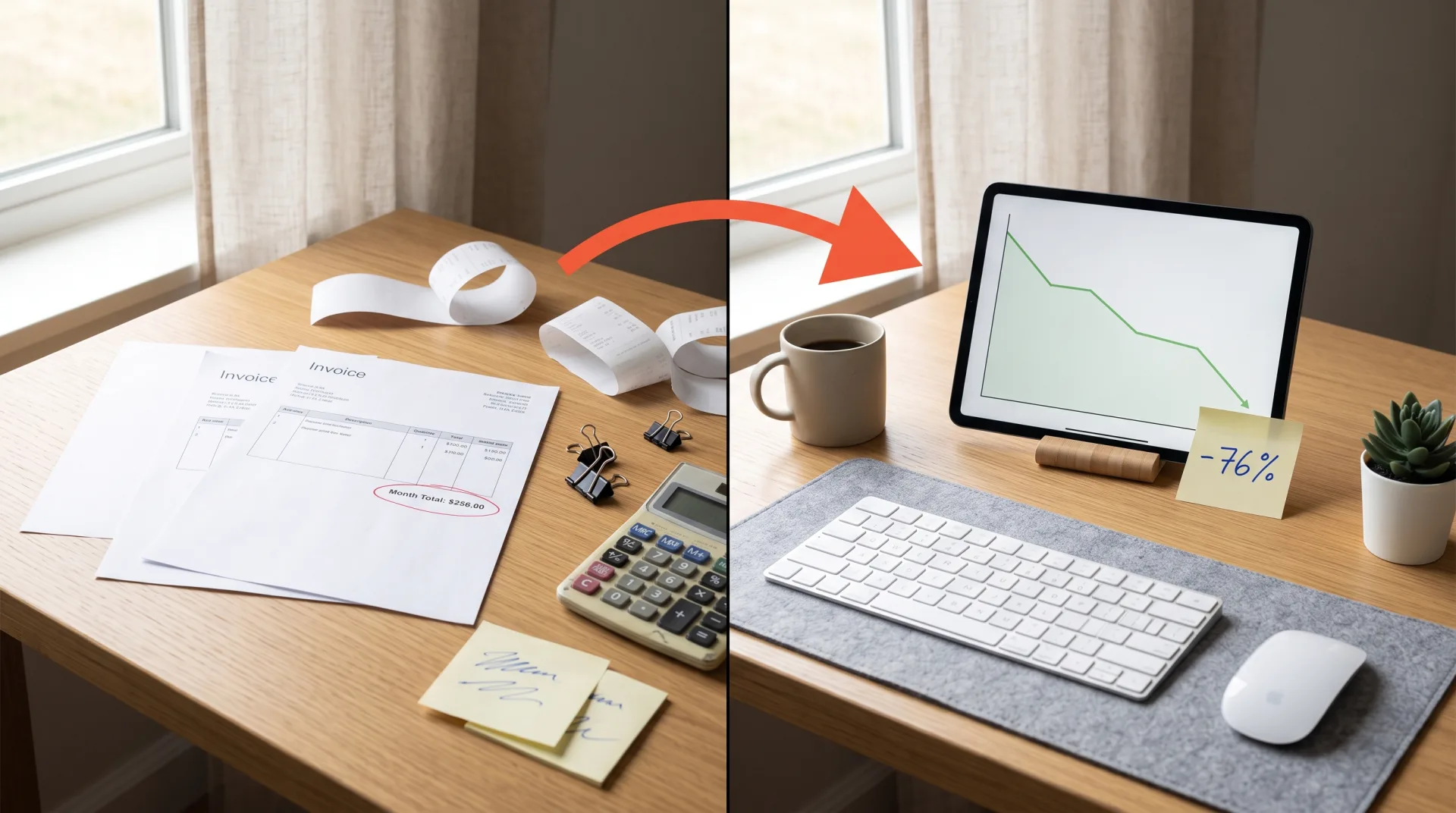
The only published small-team cloud repatriation we could find cut a peak monthly invoice from $559.36 to $132.96. Digital Society, a bootstrapped startup co-op, moved from AWS plus DigitalOcean to Hetzner cloud in Nuremberg (Digital Society, 2 October 2025). A 76% cut is real money for a bootstrapped team and still small enough for migration work to eat.
Most writing on cloud repatriation defines the term. This piece starts from published bills.
By Dan Colta. NodeSparks is a two-person EU automation studio building owned automations for SME teams. We run our own automation stack on rented EU servers. That is not a repatriation. Every figure below is a company's own published number or our labelled arithmetic.
Key Takeaways
- The one published small-team exit cut a $559.36 peak monthly invoice to $132.96 on Hetzner cloud (Digital Society).
- The big wins need big steady bills. 37signals' cloud bill fell from $3.2 million a year to $1.3 million (37signals) before its owned servers, planned at about $840,000 a year. OneUptime reports saving over $1.2 million a year on its own racks (OneUptime).
- Hetzner's 15 June 2026 repricing took the CCX13 from $18.49 to $50.49 a month (Hetzner). Against an AWS m7i.large on demand in Frankfurt at $88.15, the gap fell from 4.8x to 1.7x (our arithmetic).
- AWS waives exit egress on request (AWS) and EU switching charges end on 12 January 2027 (European Commission). Running egress is the bill that stays.
What do published cloud repatriation case studies actually show?
Large, steady savings at companies with large, steady bills. The one small case cut its peak invoice by $426.40 a month (Digital Society). The biggest published exit started from a 2022 cloud bill of $3.2 million (37signals), about 477 times Digital Society's annualised peak invoice on our arithmetic. Scale decides whether a case applies to you.
| Company | Move | Bill before | Bill after or stated saving | Transfers to a 5-50 person team? |
|---|---|---|---|---|
| Digital Society | AWS plus DigitalOcean to Hetzner cloud | $559.36 a month (peak invoice) | $132.96 a month, -76% | Yes |
| OneUptime | AWS to colocated racks | $38,000+ a month | Over $230,000 a year (2023), over $1.2 million a year (2025) | Partly |
| 37signals, total cloud bill | AWS compute to Dell servers at Deft | $3.2 million a year (2022) | $1.3 million a year (2024), all of it S3 | No |
| 37signals, storage | S3 to Pure Storage | Just under $1.5 million a year (2025) | About $1.5 million of hardware, under $1 million of support over five years | No |
| Airbus | 70 of 900 critical apps from AWS to Scaleway, for sovereignty | Not disclosed | None disclosed | No |
Sources linked below, retrieved 26 September 2026. The last column is our judgement on bill size and staffing.
37signals planned about $600,000 of Dell servers, amortised at $120,000 a year, plus about $720,000 a year of data-centre services (37signals, 21 February 2023). Just under $1 million of the $3.2 million was S3. On our arithmetic, that $840,000 a year replaced about $2.3 million of non-S3 cloud spend, a planned net saving of about $1.46 million a year, in line with the post's own $7 million over five years. The hardware came to about $700,000 and was recouped during 2023, with the same team managing everything (37signals, 17 October 2024). The company projects well over $10 million of savings over five years, S3 exit included. These are its own unaudited figures.
The S3 leg replaced just shy of $1.5 million a year of AWS storage (2025) with about $1.5 million of Pure Storage hardware plus a bit less than $1 million of support over five years (37signals, 26 March 2025). The move ran under AWS's exit waiver: 37signals negotiated 90 days to move about five petabytes, then received AWS credits for the bandwidth once it proved the data was all out (37signals, 8 January 2026).
OneUptime, an open-source observability company, is the smallest published owned-hardware exit we found. It left an AWS bill of $38,000+ a month for a colocated rack of servers bought for $150,000 plus about $5,500 a month in op-ex. It stated the saving as over $230,000 a year (OneUptime, 30 October 2023). Two years on, it reports over $1.2 million a year (OneUptime, 29 October 2025). That post does not publish the AWS bill it compares against. We read it as pricing today's larger footprint.
Airbus is moving 70 of its 900 most critical applications from AWS to Scaleway for sovereignty reasons (The Register, 16 July 2026). It disclosed no saving.
Is cloud repatriation actually a wave?
It is a drift. Flexera's 2026 State of the Cloud survey of 753 respondents found the share of workloads and of data that organisations have repatriated each rose by only 2 percentage points year over year (Flexera, 18 March 2026). IDC says only 8-9% of companies plan full workload repatriation (IDC, 28 October 2024).
IDC finds larger organisations repatriate more than smaller businesses, with most moves covering a piece of a workload such as production data or backups (IDC). Neither survey describes a 5-50 person team: Flexera's SMB bracket runs up to 1,000 employees.
Flexera also puts waste at 29% of cloud spend (Flexera). Trim before you move, the measure-first order of the SaaS replacement playbook.
What does the same small server cost on AWS and Hetzner in 2026?
Less of a gap than before June. AWS's m7i.large (2 vCPU, 8 GiB) costs $0.12075 an hour on demand in Frankfurt (AWS EC2 price file, retrieved 26 September 2026), which is $88.15 a month on our arithmetic. Hetzner's CCX13 was $18.49 before 15 June 2026 and is $50.49 for new orders now (Hetzner price table, retrieved 26 September 2026).
Read the AWS bar as a ceiling. It excludes storage and egress. A Savings Plan or Reserved Instance would narrow the gap; we found no citable price for one.
The Hetzner bar moved in June. Hetzner raised prices for new orders from 15 June 2026, citing "the massive increase in procurement costs" (Hetzner, 27 May 2026). The CCX13 (2 dedicated vCPU, 8 GB of RAM, 80 GB of NVMe, 20 TB of EU traffic, per Hetzner) went from EUR 15.99 to EUR 42.99, up 168.9%. The percentage is our arithmetic and prices exclude VAT.
Existing contracts keep their terms. Digital Society runs ARM shared-vCPU cloud servers (Digital Society), Hetzner's CAX line, priced before June. New CAX orders now cost 30-33% more: the CAX11 went from EUR 4.49 to EUR 5.99 and the CAX41 from EUR 31.49 to EUR 40.99 (Hetzner price table, retrieved 26 September 2026; percentages are our arithmetic).
A GPU server changes the arithmetic entirely: see the self-hosted AI payback period.
Which costs do people forget in both directions?
Running egress on the cloud side, people and refresh on the owned side. AWS charges $0.090 per GB out of Frankfurt after 100 GB a month free (AWS), while Hetzner's CX and CAX cloud servers include 20 TB of EU traffic (Hetzner traffic docs). On the owned side, OneUptime logs about 14 engineer-hours a month of infrastructure toil (OneUptime).
| Cost | What the published numbers say | Who pays it |
|---|---|---|
| Exit egress | AWS waives it on request with 90 days to move; EU switching charges end on 12 January 2027 | Leavers, once |
| Running egress | $0.090 per GB out of Frankfurt, against 20 TB included on Hetzner cloud and EUR 1 per TB after | Stayers, monthly |
| Ops time | About 14 engineer-hours a month at OneUptime; 37signals kept the team it already had | Leavers, monthly |
| Hardware refresh | 37signals assumes a five-year life; OneUptime can refresh 40% of its fleet every 24 months | Hardware owners |
| Colocation | About $5,500 a month op-ex for OneUptime's first rack (2023) | Hardware owners |
| Rented-side price risk | Hetzner new-order prices up from 15 June 2026; existing contracts keep their terms | Renters, at the next order |
Egress: the exit is nearly free, the running bill is not
AWS waives exit egress from any region on a request to AWS Support, with 90 days to finish since its 30 September 2025 update (AWS). The EU Data Act removes switching charges, egress included, from 12 January 2027 (European Commission).
Running egress is the cost nobody waives. AWS charges $0.090 per GB for the first 10 TB a month out of Frankfurt and $0.085 per GB for the next 40 TB (AWS price list, published 16 September 2026, retrieved 26 September 2026). Hetzner's traffic docs, covering cloud and root servers, price cloud overage at EUR 1 per TB, $1.20 in Hetzner's own USD figure. Root servers get unlimited traffic on a 1 Gbit uplink (Hetzner).
Each extra terabyte costs $92.16 at AWS's first tier (1,024 GB at $0.090) against Hetzner's $1.20, about 77 times more (our arithmetic). If you serve media to the public, that line can outgrow the servers.
Ops time and hardware refresh
OneUptime is the only operator we found that published a measurement of the work: about 14 engineer-hours a month of toil, close to two working days (our arithmetic), with 99.993% measured availability over 730+ days (OneUptime, 29 October 2025). It says its AWS era took similar time on different work.
Refresh is the cost the cloud folds into its price. 37signals did its maths on a five-year server life and calls that conservative (37signals, 19 December 2023). A 2015 fleet ran over 3,500 days at a fully amortised $142 a day (37signals, 7 February 2025). OneUptime says it can refresh 40% of its fleet every 24 months and still undercut an optimised AWS bill (OneUptime).
Where do you land when you leave the cloud?
In one of three places that all get called repatriation. 37signals owns Dell servers hosted by Deft, a white-glove data-centre provider (37signals). OneUptime put the op-ex of its first colocated rack at about $5,500 a month in 2023 (OneUptime). Hetzner rents an AX42 dedicated server (AX42-1) for EUR 97.30 a month plus EUR 49 setup (Hetzner price table, retrieved 26 September 2026).
- Owned hardware in colocation. Capex, a five-year horizon and someone who owns the machines.
- Rented dedicated servers. A monthly price instead of capex, while you still run everything from the operating system up.
- A smaller cloud or VPS provider. Virtual servers billed monthly, as with Digital Society. For most small teams this is what leaving a hyperscaler means.
The office half of an EU-only setup is covered in leaving Google Workspace as an EU company. If your rented server will run a workflow engine, read what self-hosted n8n costs in production first.
When is cloud repatriation the wrong call?
When the people who left say so. 37signals draws the line at regular demand spikes of 5-10x or higher over baseline (37signals). Its exit announcement said the cloud makes sense for an application "so simple and low traffic that you really do save on complexity by starting with fully managed services" (37signals, 19 October 2022).
OneUptime lists three reasons to stay (OneUptime):
- Usage that is "spiky or seasonal and you can auto-scale to near zero between peaks".
- Heavy reliance on managed services such as "Aurora Serverless, Kinesis, Step Functions".
- No "appetite to build a platform team comfortable with Kubernetes, Ceph, observability".
Three more follow from the numbers.
- The absolute saving is small. Price your migration hours and on-call time against it.
- Nobody on the team runs servers today. 37signals kept a team it already had. You would be hiring or learning.
- Waiting is cheap. With exit egress waived on request, staying costs only the monthly difference.
The same reasoning for software seats is in build the internal tool or buy the seat.
The small-team version of the decision
Price one workload rather than the whole estate. At 2026 list prices a 2 vCPU, 8 GB server costs $88.15 a month on demand at AWS Frankfurt and $50.49 at Hetzner (Hetzner price table), a $37.66 monthly difference on our arithmetic.
- Find the egress line on your bill. At AWS's Frankfurt rates, 5 TB a month out costs $451.80 (our arithmetic). A large one outweighs any server price.
- Run 37signals' 5-10x spike test on your load. Every published win had steady load.
- Name the person who patches. Budget OneUptime's 14 hours a month.
- Move one steady workload first to a rented EU server or VPS, then compare a full month of bills.
- Plan the migration before you ask AWS for the egress waiver. You get 90 days to finish.
Self-hosting a social media scheduler shows the same trade at application level: the server bill is small and the real cost moves elsewhere.
The bottom line
Cloud repatriation pays when the bill is large and steady and someone already runs servers, the footing behind 37signals' exit (37signals). At small-team scale the one published case cut a $559.36 peak invoice by 76%. Hetzner's June 2026 repricing has since narrowed the like-for-like server gap to 1.7x against AWS on demand.
For a 5-50 person team the default is to stay, watch the egress line and move one steady workload when the numbers justify it.
If what you are weighing is an automation rather than a server, the Ops Automation Playbook ranks which ones to own first. For the wider case on which parts of a stack to own at all, the NodeSparks cluster pillar is the Own Your Stack manifesto.
If the thing you want off the bill is a subscription rather than a server, that is business process automation and the arithmetic in this post does not apply.
Frequently asked questions
What is cloud repatriation?
Cloud repatriation means moving workloads off a hyperscale public cloud such as AWS, whether onto hardware you own in a colocation facility, onto rented dedicated servers or onto a smaller cloud or VPS provider. Most of it is partial. IDC says only 8-9% of companies plan full workload repatriation, with most moving a piece of a workload such as production data or backups. Flexera's 2026 State of the Cloud survey of 753 respondents found the repatriated share of workloads and of data each rose by only 2 percentage points year over year.
How much did 37signals save by leaving the cloud?
37signals spent $3.2 million on cloud in 2022. By 2024 that cloud bill was down to $1.3 million a year, all of it S3. That drop is the cloud bill only. Its plan put owned servers and data-centre services at about $840,000 a year against about $2.3 million of non-S3 cloud spend, a planned net saving of about $1.46 million a year on our arithmetic. Including the S3 exit, it projects well over $10 million saved over five years. These are its own unaudited figures, at a scale that does not transfer to a 5-50 person team.
Is cloud repatriation worth it for a small team?
Only when the bill is steady and the saving covers the time. The one published small-team exit we found, Digital Society, moved from AWS plus DigitalOcean, with a peak monthly invoice of $559.36, to Hetzner cloud at $132.96. That cut the peak invoice by $426.40, or 76%, on our arithmetic. That is real money for a bootstrapped company. It is also small enough for migration work and on-call time to eat. IDC finds larger organisations repatriate more than smaller businesses.
Is Hetzner still cheaper than AWS after its 2026 price increase?
Yes, by less. For new orders from 15 June 2026, Hetzner's CCX13 (2 dedicated vCPU, 8 GB RAM) went from $18.49 to $50.49 a month in Hetzner's own USD column, excluding VAT. AWS's m7i.large with 2 vCPU and 8 GiB costs $88.15 a month on demand in Frankfurt on our arithmetic, before storage and egress. The gap fell from about 4.8x to 1.7x. An AWS Savings Plan or Reserved Instance would narrow it further. Existing Hetzner contracts keep their old terms.
Do you have to pay egress fees to leave AWS?
Not in the end, if you ask. AWS waives data transfer out charges for customers moving off AWS, from any region, on a request to AWS Support. Since its 30 September 2025 update you get 90 days to complete the move. 37signals negotiated 90 days for its S3 exit and received AWS credits for the bandwidth once it proved the data was all out. The EU Data Act removes switching charges, egress included, from 12 January 2027. Running egress is separate: AWS charges $0.090 per GB out of Frankfurt after 100 GB a month free.
When should a company stay on the public cloud?
When the people who left say so. 37signals draws the line at regular demand spikes of 5-10x or higher over baseline. OneUptime, which left AWS for its own colocated hardware, says to stay if your usage is spiky or seasonal enough to auto-scale to near zero between peaks, or if you depend on managed services such as Aurora Serverless, Kinesis or Step Functions. It also says to stay if you have no appetite to build a platform team comfortable with Kubernetes, Ceph and observability.