
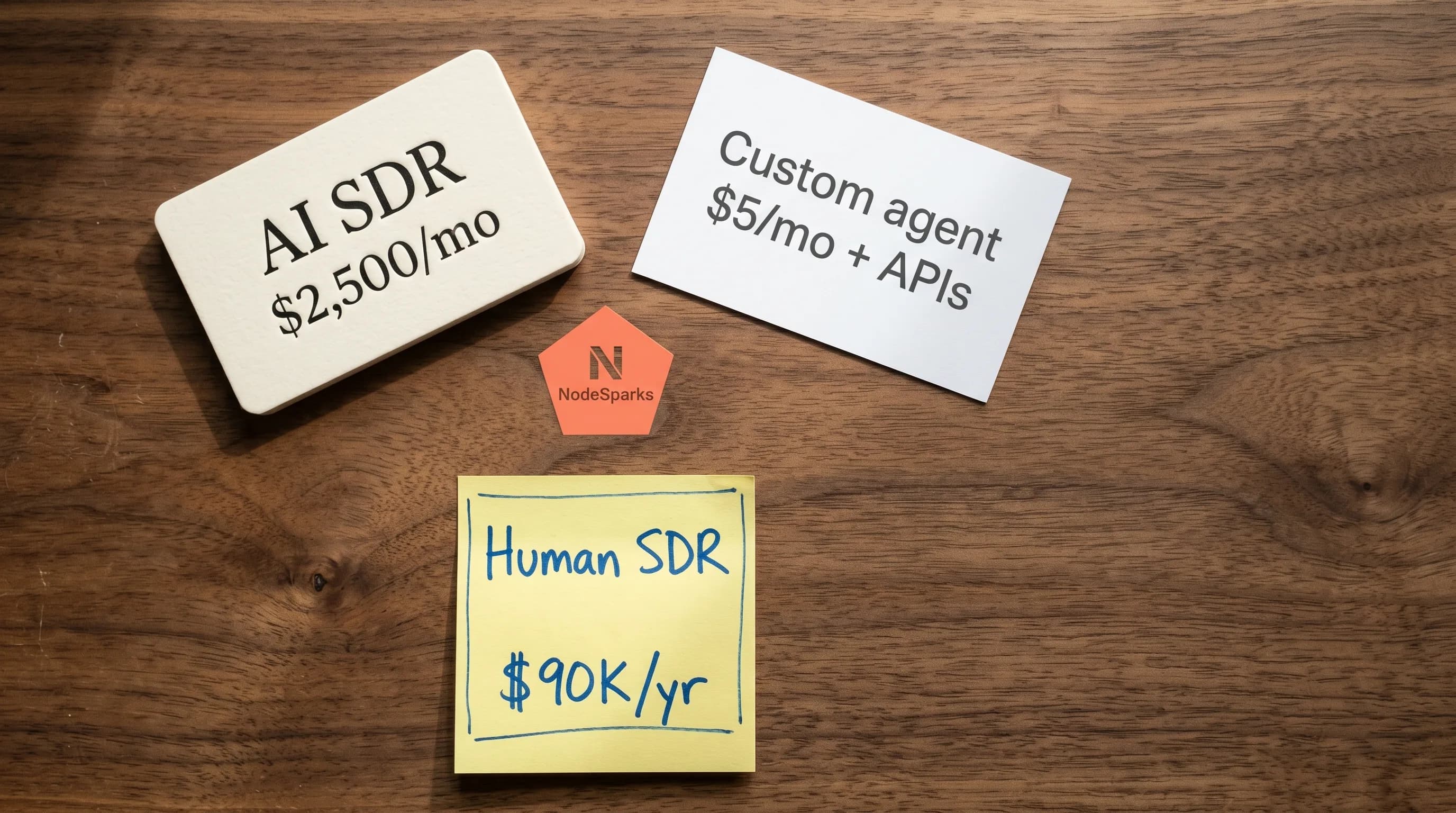
An AI SDR is a software system that does the top-of-funnel work of a human sales development representative — prospect research, list enrichment, personalized first-touch outreach, follow-ups, and meeting booking. Commercial AI SDRs (AiSDR, Artisan, 11x) are vendor-hosted SaaS charging $250–$2,500/month; a custom outreach agent on the Anthropic or OpenAI APIs does the same volume for roughly $5–$50/month all-in. This piece is the honest 2026 build-vs-buy read on when each one is worth it.
The top Reddit thread that ranks for "AI SDR" right now is titled "Has anyone found an AI SDR that actually works?" — one year old, 70+ comments, mostly skeptical. The first three organic results are vendor-funnel listicles each ranking their own product #1. The category is loud, well-funded, and at the same time the buyers are visibly unconvinced.
This is the build-vs-buy version of that question, with real 2026 pricing and the case for the third option nobody talks about: keep what you have, replace just the tooling.
It's a spoke off the broader SaaS replacement playbook — same logic, applied to the AI SDR category specifically. If you've already read our Apollo alternative piece, this is the more general version of the same conversation.
Key Takeaways
- Commercial AI SDR pricing spans $250-$2,500/month at entry-to-mid tiers (Artisan, AiSDR), with enterprise contracts in the $40K-$120K/year range (Artisan Pricing; AiSDR Pricing, retrieved 2026-05-29).
- A custom outreach agent built on the Anthropic or OpenAI APIs runs $5-$50/month all-in for the same volume profile. Build effort: 20-40 hours.
- The Reddit and Hacker News discourse on AI SDR effectiveness is skewing more skeptical, not less, through 2026. Vendor case studies show wins; buyer threads show middling-to-poor results in the wild.
- The decision isn't binary "buy AI SDR vs hire human" — most SMEs benefit more from a stack-replacement (enrichment + personalization + sending), with a part-time operator running the workflow.
- SMB SaaS spend per employee grew 21% YoY to $4,830 in 2025; AI SDR is one of the fastest-growing line items in that bill (Zylo 2025 SaaS Management Index).
What does an AI SDR actually do?
An AI SDR is a software system that performs the top-of-funnel sales work normally done by a human sales development representative — research a prospect, write a first-touch message that doesn't read as templated, follow up on a cadence, book meetings into a calendar (IBM, AI SDRs Explained, April 2026; Salesforce, What is an AI SDR, April 2025). The job is well-defined, repetitive, and bounded — exactly the shape of work LLMs got good enough at around 2023-2024 to credibly automate.
The category in 2026 splits into three groups. There are the full-stack AI SDR products — AiSDR, Artisan AI, 11x (raised a $50M Series B led by Andreessen Horowitz in late 2024 at a ~$350M valuation, TechCrunch, Sept 30, 2024), Regie, Bosh, Fin.ai — that own the entire workflow from list-building through send. There are the enrichment-first products (Clay, Apollo, Common Room) that increasingly bolt on AI-message generation on top of their original data layer — where the real build-vs-buy decision is Clay or a custom enrichment agent you own. And there is the long tail of "AI replies to inbound" tools that don't really do outbound at all but pattern-match into the same search results. For this piece, "AI SDR" means the first group — fully-automated outbound SDR-replacement software.
How much does an AI SDR actually cost in 2026?
Pricing varies more than any other category we cover. At the entry tier the gap is roughly 4×; at the mid-tier the gap is roughly 4×; at enterprise tiers the gap closes because everyone converges on $40K-$120K annual contracts.
| Vendor | Entry tier | Mid tier | What entry tier gets you |
|---|---|---|---|
| Artisan AI | Intern: $250/mo annual | Employee: $600/mo annual | 12K credits/mo, expected 1-12 positive replies |
| AiSDR | Explore: $900/mo quarterly | Grow: $2,500/mo quarterly | 1,200 AI messages, ~3 meetings |
| 11x | Custom quote (typically $50K-$120K/yr) | — | Full Alice/Mike agent deployment |
| Custom Python/TS agent | ~$5/mo hosting + APIs | ~$20/mo at high volume | Whatever you build it to do |
Two notes on this table. First, "expected positive replies" or "estimated meetings" are vendor-supplied numbers from their case-study averages; your mileage depends heavily on list quality and ICP fit. The honest read on those numbers: they're achievable in a well-segmented ICP, often unachievable in a noisy one.
Second, AiSDR's "3 meetings on $900/month" math works out to $300 per booked meeting on the entry tier. For a $5K ACV product that's reasonable. For a $1K ACV product it's terrible. For a $50K ACV product where one meeting can become a deal, it's a bargain.
The custom Python or TypeScript agent end of the table is the one most teams underestimate. The actual delivered workflow — enrichment, personalization, sending, reply parsing, CRM sync — is 300-800 lines of code in 2026, ships in 20-40 engineering hours, and runs on $5-$20/month of hosting plus per-message API cost. We covered the architecture for this in the Apollo alternative custom outreach agent post. The same pattern works as an AI SDR replacement.
When does an AI SDR actually work?
There is a profile of team where commercial AI SDRs genuinely earn their cost. It's narrower than the vendor marketing suggests but it's real.
The profile: a B2B SaaS or services company with a clearly-defined ICP, 5,000+ qualified targets per month, a non-technical sales team that needs a visual UI and dashboard, and an ACV high enough that even a 1% reply rate at high volume covers the subscription. In that profile, an AI SDR product replaces what would otherwise be 1-3 junior SDRs at fully-loaded cost of $90K-$200K/year each. The math is straightforward and the buying signal is clear.
What the commercial AI SDR buys you that the custom path doesn't:
- A visual UI a non-engineer can edit campaigns in
- Built-in deliverability monitoring with vendor relationships at Google/Microsoft
- Pre-integrated CRM sync (HubSpot, Salesforce) without writing webhook code
- A vendor compliance posture (SOC 2 mostly, GDPR partial, SPF/DKIM/DMARC handled)
- Support staff who answer questions about why a campaign isn't performing
If those things are load-bearing for your team — particularly the visual UI for non-engineers and the deliverability infrastructure — paying $600-$2,500/month is a reasonable trade. Stop reading. Buy Artisan Employee or AiSDR Grow. Move on.
When does an AI SDR actually not work?
The unhappy population is much larger than the vendor marketing acknowledges. The top Reddit thread for "AI SDR" — still ranking on the first page a year after it was posted — is full of operators reporting middling-to-poor results despite paying full price (r/SaaS, Has anyone found an AI SDR that actually works?). The complaints cluster into three repeating shapes.
Shape one: AI-written outbound is increasingly detectable, and buyer tolerance is dropping. Through 2024 you could send a well-prompted AI-written cold email and have it pass for human-written. By mid-2026 buyers — particularly in tech, marketing, and product roles — have developed visible allergies to AI-shaped openers. A widely-cited March 2025 Hacker News thread titled "11x has been claiming customers it doesn't have" surfaced exactly this kind of buyer-side skepticism about vendor claims in the category (Hacker News, 2025). The dead-giveaway patterns ("I noticed your work on...", "Quick question about your approach to..." followed by an obvious tool-pull from a LinkedIn bio) are now reply-rate-killers. Vendor products that don't aggressively evolve their prompt templates get caught in this drift, and operators feel it as falling reply rates over time.
Shape two: high-ACV, small-list motions don't benefit from automation. If your ICP is 200 companies and your ACV is $80K, the value of personalization is enormous and the value of throughput is zero. You don't need an AI SDR. You need a thoughtful human writing 10 emails a week. The AI SDR economics break down because the per-meeting cost on the vendor pricing assumes you're running high volume.
Shape three: vertical or compliance-sensitive niches where every send needs review. Healthcare, financial services, regulated industries — anywhere a non-compliant outbound message can cost the company more than a year of SDR salary — usually can't safely deploy an autonomous AI SDR. The compliance review burden eats the throughput advantage.
There's a fourth, subtler shape: the AI SDR works fine on the metrics the vendor reports (delivered messages, opens, even replies), but the replies turn out to be polite-no's at a much higher rate than the team's previous human-written outreach. The vendor dashboard says win; the pipeline says loss. We've seen this on more than one client review.
What's the third option nobody sells?
Most SMEs we work with arrive convinced the decision is "buy an AI SDR product" versus "hire a human SDR." Both are usually wrong for the stage they're at.
The third option, which doesn't appear in any AI SDR vendor's marketing for obvious reasons: keep your existing human ops capacity, replace just the SaaS stack underneath them with a custom enrichment-and-personalization workflow. The operator (existing — could be a marketing lead, founder, or fractional ops person) spends 5 hours a week reviewing AI-drafted messages, sending the good ones, archiving the bad ones, replying to inbound by hand.
The math is dramatically better. Take a 100-message-per-week outbound motion:
| Setup | Monthly cost | Owns the stack? | Personalization quality |
|---|---|---|---|
| Hire junior SDR | $7K-$12K (fully loaded) | N/A | High, but slow |
| Commercial AI SDR (mid-tier) | $600-$2,500 | No | Vendor-controlled, drift over time |
| Custom enrichment-and-send stack + existing operator at 5hr/wk | $50-$200 | Yes | Operator-controlled, human-quality |
The custom stack is roughly: a sourcing layer (Clay subscription or a custom enrichment agent built on the same pattern as the Apollo alternative outreach agent), an LLM call to Claude or GPT-5 for first-touch personalization, an email sender (Instantly, Smartlead, or a Postmark/Mailgun setup), a CRM webhook, and a Slack channel where the operator approves messages before they go out.
Build effort: 20-40 hours one-time. Ongoing operator time: 5 hours per week. Run cost: under $200/month all-in. Every message still passes a human eye before it sends.
Why does this conversation feel familiar?
If this conversation feels familiar, it is. The build-vs-buy question for AI SDRs in 2026 is structurally identical to the build-vs-buy question for workflow automation we covered in n8n alternatives — and when to skip n8n entirely and the broader Zapier vs n8n vs Make vs custom code comparison. Same shape, different category.
In all three categories the answer is the same:
- At low volume + non-technical operator + commodity workflow → buy the SaaS
- At high volume + technical capacity + custom requirements → build the code
- In the middle (which is most SMEs) → the third option exists and usually wins, but nobody sells it because there's nothing to sell
The AI SDR category is just newer and more loudly marketed, which makes the third option harder to see.
How to decide in 90 seconds
Four questions, in order.
1. Do you actually have 5,000+ qualified targets per month? If no → an AI SDR is wrong-sized for you. Stop here. Run the manual + custom-stack option.
2. Is your ACV under $5K or over $50K? Under $5K → AI SDR makes sense if the volume math works (question 1 says yes). Over $50K → AI SDR is usually wrong; thoughtful low-volume human outreach wins. Between → the custom stack with operator review wins for most teams.
3. Do you have an in-house operator who could spend 5 hrs/week on the workflow? Yes → the custom stack is the right answer. No → buy Artisan Intern at $250/mo as the lightest commercial option and revisit in 6 months when you have hired an ops person.
4. Are you in a regulated industry (healthcare, financial, legal)? Yes → autonomous AI SDRs are usually unsafe. Run with human review on every send, regardless of which tool sources the message.
Most teams land on either custom stack with operator review, or the cheapest tier of a smaller vendor. Almost nobody who runs this decision tree honestly lands on the $2,500/month tier.
What does the AI SDR conversation look like in 12 months?
Three predictable shifts from where the category sits today.
Buyer tolerance for AI-written cold outreach continues dropping. The vendors that survive are the ones that aggressively evolve prompt templates and add genuinely human-in-the-loop options. The vendors that stay on autopilot get a slowly-eroding base of customers churning out as their reply rates drift down.
The middle of the market consolidates around the custom-stack pattern. Open-source tooling for enrichment, personalization, and sending is now mature enough that the build-effort for a custom outreach agent is half what it was 18 months ago. The "buy" case keeps narrowing.
The high end stays expensive and worth it for a specific profile of company. The $50K-$120K annual contracts at 11x and the enterprise tier of AiSDR are real for enterprise buyers who need the dashboard, the integrations, the SOC 2 posture, and the SLA. The mid-market squeeze is where most of the churn happens.
So is the AI SDR category a scam or not?
AI SDRs are real software, doing real work, sold at real prices. They're also one of the loudest examples of the AI-wrapper SaaS trap that the whole category sits inside, a category whose vendor marketing has run ahead of the buyer reality, which is why the top organic result for "AI SDR" is still a one-year-old Reddit thread asking whether any of them actually work.
The right answer for most SMEs in 2026 isn't on either end of the build-vs-buy spectrum. It's the third option: a custom enrichment-and-personalization stack owned by your existing ops capacity, costing under $200/month, with a human still reading every message before it sends. The commercial AI SDR is right for a specific company shape — high-volume, mid-ACV, non-technical sales team — and that shape is narrower than the marketing makes it sound.
If you're weighing the decision and want a second opinion on which tier of the spectrum you actually sit in, that's the kind of build-vs-buy conversation we run at NodeSparks. The pillar piece on cross-category replacement is the SaaS replacement playbook; this is the AI SDR-specific application of that framework.
The category isn't a scam. It's just sold to a much wider audience than it works for.
Frequently asked questions
What is an AI SDR?
An AI SDR is a software system that performs the top-of-funnel sales work normally done by a human sales development representative — lead research, list enrichment, personalized outbound messages, follow-ups, and meeting booking. Most commercial AI SDRs (AiSDR, Artisan AI, 11x, Regie, Bosh) are vendor-hosted SaaS products charging $250-$2,500 per month depending on volume. The category emerged around 2023-2024 as LLM quality crossed the threshold needed to write outbound messages that don't immediately read as templates, and is now an active product category in its own right ([IBM, AI SDRs Explained, 2026](https://www.ibm.com/think/topics/ai-sdr); [Salesforce, What is an AI SDR, 2025](https://www.salesforce.com/sales/ai-sales-agent/ai-sdr/)).
How much does an AI SDR cost in 2026?
Commercial AI SDR pricing spans roughly 20× across vendors. Entry tiers: Artisan Intern at $250/month (12K credits, expected 1-12 replies) and AiSDR Explore at $900/month (1,200 messages, ~3 meetings). Mid-tier: Artisan Employee at $600/month (30K credits) and AiSDR Grow at $2,500/month (4,500 messages, ~11 meetings) ([Artisan Pricing](https://www.artisan.co/pricing); [AiSDR Pricing](https://aisdr.com/pricing), retrieved 2026-05-29). Enterprise tiers are custom-quoted, typically $40K-$120K annually. A custom outreach agent built on the Anthropic or OpenAI APIs runs $5-$20/month hosting plus per-message API cost (typically $0.001-$0.01 per personalized message at current 2026 LLM prices).
Will AI SDRs replace human SDRs?
For pure top-of-funnel outbound at high volume, partially — the work AI does well (research, list building, first-touch personalization, follow-up cadence) overlaps significantly with a junior SDR's job. For the work humans still do better — interpreting an unexpected reply, navigating a complex multi-stakeholder buying committee, building relationships across multiple conversations — the gap is closing but not closed. Most teams in 2026 land on hybrid: AI handles volume and personalization at the top of the funnel, humans handle anything that requires judgment past the first reply. Full replacement happens at low-ACV, high-volume motions where the cost of a missed nuance is small. It rarely happens at $50K+ ACV deals where one bad reply costs more than a year of human salary.
Are AI SDRs actually effective?
Mixed, and the public discourse skews skeptical. The top Reddit thread on the topic is titled 'Has anyone found an AI SDR that actually works?' and has 70+ comments after one year online, the bulk reporting middling-to-poor results ([r/SaaS, 2025](https://www.reddit.com/r/SaaS/comments/1iea3x3/has_anyone_found_an_ai_sdr_that_actually_works/)). Where AI SDRs work well: high-volume outbound into well-segmented lists with clear intent signals, businesses where 'good enough' personalization beats no outreach at all. Where they struggle: small-list high-ACV motions where every message needs to feel one-to-one, regulated industries where compliance review is required per send, and any market segment where buyers have grown allergic to AI-written outbound (which is a growing population in 2026).
Should I build my own AI SDR or buy one?
Three questions decide it. First, do you actually have 5,000+ qualified targets per month? If not, the price-per-meeting on commercial AI SDRs ($200-$300+ at the entry tier) rarely justifies the spend over a part-time human SDR. Second, do you have engineering capacity to maintain a custom agent? A working custom outreach system is 300-800 lines of code, ships in 20-40 hours, and costs $5-$50/month to run — but you own the maintenance. Third, do you need the visual UI and reporting layer commercial products provide, or is a CSV + a Slack channel enough? Teams with technical capacity and a clear ICP almost always do better building. Teams without either are better off with a commercial product, ideally the cheapest tier of a smaller vendor like Artisan Intern.
What's the alternative to both AI SDR and human SDR?
Stop thinking of it as a person-replacement question and start thinking of it as a stack question. Most SMEs don't need an AI SDR or a human SDR for outbound at their current stage — they need a high-quality enrichment-and-personalization stack that a part-time operator can run for 5 hours per week. That stack today is roughly: a sourcing tool (Clay or a custom enrichment agent), an email-sending platform (Instantly, Smartlead, or a custom sender on Mailgun/Postmark), an LLM call for personalization (Claude or GPT-5), and a CRM webhook. Run cost: under €200/month all-in. The human time is 5 hours per week, owned by an existing operator. We covered this exact stack in the [Apollo alternative custom outreach agent](/blog/apollo-alternative-custom-outreach-agent) — the same pattern applies to AI SDR replacement.