
Project Overview
Talentbridge is an 18-person recruiting agency running EU and US placements across software engineering and product roles. Their inbound CV flow was drowning the team: 11 hours a week just on triage — opening the PDF, scanning for role match, forwarding to the recruiter who owned the appropriate vertical. By the time a strong candidate heard back, two days had passed and a competing offer had often already moved.
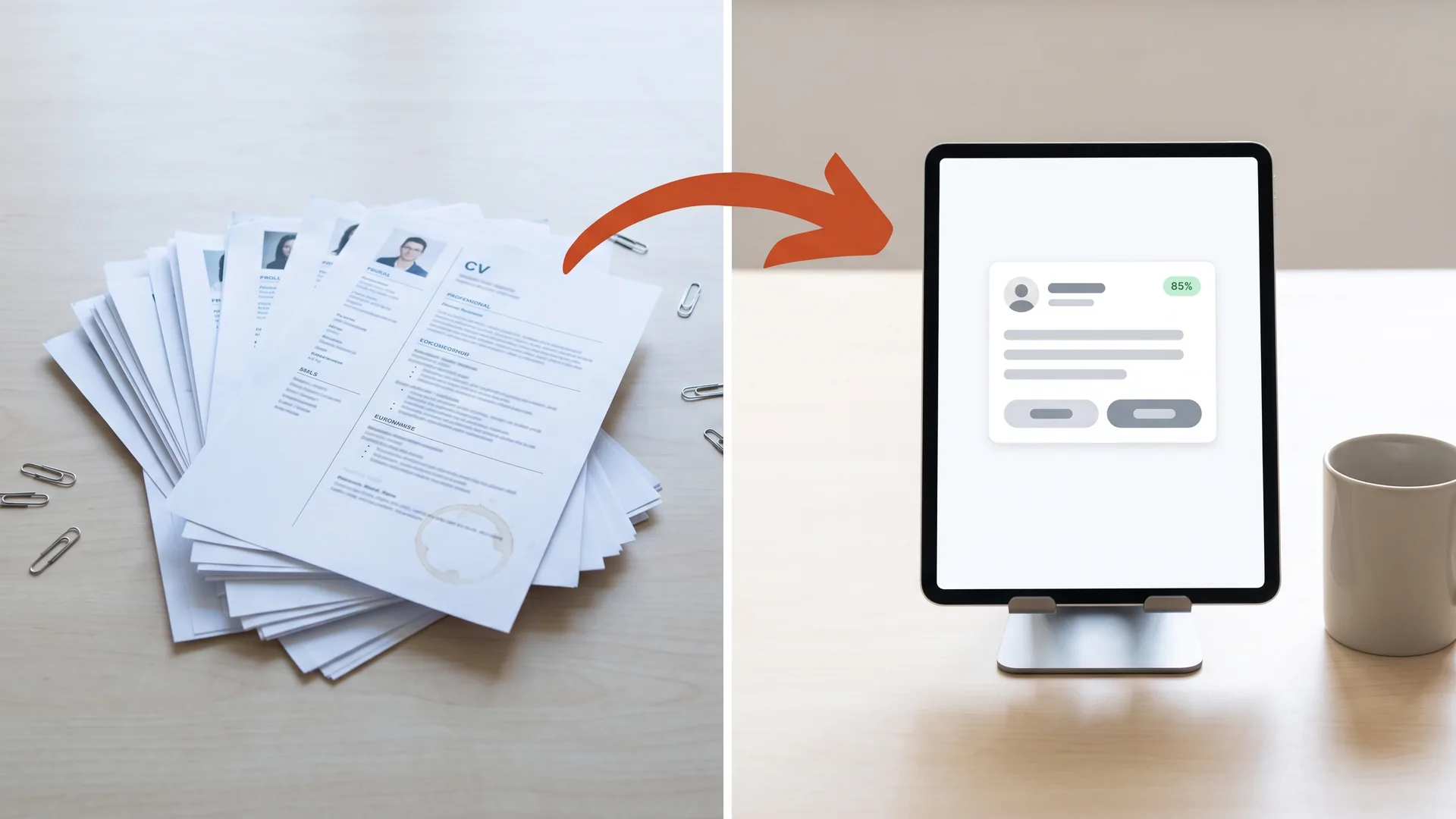
NodeSparks built a CV intake agent that parses inbound PDFs, scores against the open role's requirements, and drops a summary card into the right recruiter's Slack DM within minutes. Time to first response went from 38 hours to about 4. Two senior placements in Q1 alone closed candidates that the team confirmed would have ghosted under the old system.
The Problem
Inbound CVs arrived through three channels: the website careers form, recruiter@talentbridge.com, and forwarded from LinkedIn InMail conversations. Each channel landed in a different inbox. Each CV went through a manual triage step before reaching the recruiter who could actually act on it. The first-touch delay was costing them placements — recruiters' own estimate, after running the post-mortem on three lost candidates, was ~15% of senior pipeline.
They had looked at ATS upgrades (Greenhouse, Lever, Workable). All would have solved part of the problem and cost $300–800/mo in per-seat fees. None would have done the qualitative role-fit scoring that the human triagers were actually doing.
The Build
We built a Lane 02 agent on a 10-day timeline. The agent listens to all three inbound channels, extracts text from the CV (PDF or DOCX), pulls the open roles list from the agency's shared Notion DB, scores each CV against each open role on dimensions Talentbridge defined (years in role type, seniority signals, geography fit, tech stack match), and posts a structured summary card to the right recruiter's Slack DM with the candidate's top three role matches and a confidence score per match.
Recruiters can react with a thumbs-up to auto-reply to the candidate with a scheduling link, or open a thread to handle manually. Build cost: $3,800.
Stack
- Runtime: Claude Code for CV parsing and role-fit reasoning
- Document parsing: PDF-parse for text extraction, fallback to vision model for image-heavy CVs
- Roles source: Notion API (the agency's existing open-roles database)
- Routing: Slack DM API + Slack Block Kit for the summary cards
- Hosting: client's GitHub repo, deployed to their existing Vercel project
Outcome
- CV triage time: 11 hrs/wk → 1.5 hrs/wk (86% reduction)
- Time to first response: 38 hrs → ~4 hrs (89% faster)
- Senior pipeline conversion (post-mortem est.): +12% in Q1
- Two senior placements in Q1 directly attributed to faster response
- Avoided ATS upgrade fees: $300–800/mo not spent on Greenhouse-tier tools
“Inbound CVs were drowning the team. Eleven hours a week just triaging — opening the PDF, scanning for role match, forwarding to whichever recruiter owned that vertical. By the time a strong candidate heard back, two days had passed and someone else had moved first. NodeSparks built us a CV intake agent that parses the file, scores against the open role's requirements, and drops a summary card into the right recruiter's Slack DM within minutes. Time to first response went from 38 hours to about 4. We have closed two senior placements this quarter that would have ghosted us under the old system.”
The call is free and the written scope with its fixed number is free too. You keep the scope whether you hire us or not. Nothing is paid before work starts.