
Project Overview
CREGG is one of Ireland's established specialist recruitment firms, operating for over three decades from offices in Shannon, Limerick, Galway, Cork, Dublin, Roscommon, and Kilkenny. With a core operational team of approximately 25 consultants and support staff, they specialise in placing production operators, engineers, quality professionals, and supply chain managers for leading medical device, pharmaceutical, and manufacturing companies across Ireland's Mid-West and West regions. They rely on Mercury xRM as their primary ATS/CRM platform, integrated with Microsoft Dynamics, to manage an active pool of over 800 contingent workers at any given time.
CREGG's problem was not their website or their reputation -- it was that their operational processes had not kept pace with their growth. As the team expanded from 15 to 25 people over two years and their contingent workforce grew, the manual processes that once worked for a smaller operation became unsustainable. Consultants were spending hours each week on repetitive data entry, copy-pasting candidate information between Mercury xRM and spreadsheets, manually generating weekly compliance and placement reports, and sending individual status update emails to hiring managers. The cumulative effect was a team stretched thin, rising error rates in reporting, and consultants who should have been on the phone with candidates instead spending mornings on administrative busywork. CREGG engaged NodeSparks for a Health Check focused specifically on process and automation opportunities.
The Challenge
When NodeSparks conducted the initial Health Check in March 2025, the operational reality at CREGG was starkly at odds with their market reputation. Despite being one of the most respected recruitment firms in Ireland's Mid-West, their internal processes resembled those of an agency half their size. The operations coordinator was spending roughly 7 hours every Monday morning manually compiling the weekly placement report by pulling data from Mercury xRM, cross-referencing it against client purchase orders in Excel, and formatting it into a presentable deck. Errors in this report -- which happened roughly once every three weeks -- created cascading problems with client invoicing and contractor payroll.
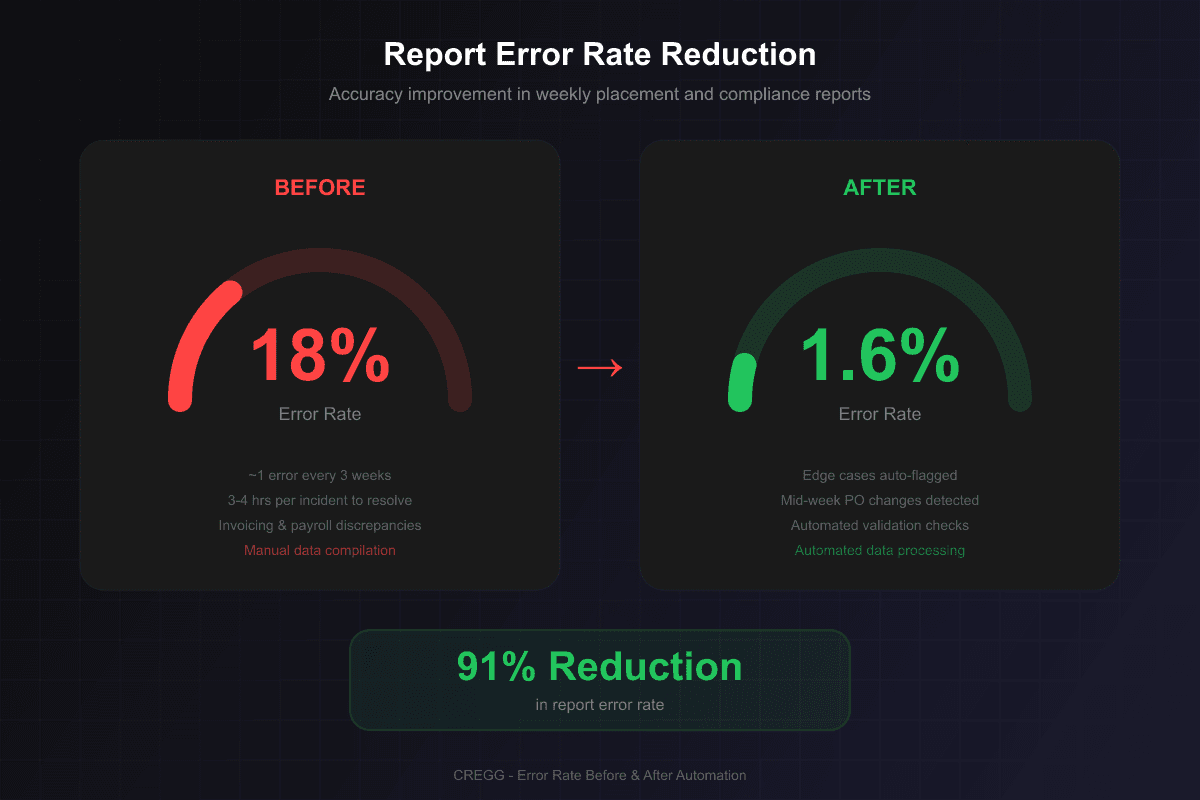
- Weekly placement and compliance reports required 7+ hours of manual compilation from Mercury xRM, Excel, and email threads. Error rate on these reports was approximately 18%, causing downstream invoicing and payroll discrepancies that took an additional 3-4 hours per incident to resolve.
- Candidate status updates to hiring managers were sent manually -- individual emails composed one by one for each active placement. Three consultants were spending a combined 12 hours per week on these communications, with inconsistent formatting and occasional missed updates.
- New candidate onboarding required data to be entered manually into Mercury xRM, then duplicated into a separate compliance tracking spreadsheet and a payroll staging document. The same candidate information was being typed into three different systems, with a measured transcription error rate of 23%.
- Client-facing weekly KPI dashboards were manually maintained in Google Sheets, with a consultant spending 4 hours each Thursday pulling placement figures, fill rates, and time-to-hire metrics from Mercury xRM. These dashboards were often a week behind real-time data.
- Document management for contractor compliance (right-to-work verification, safety certifications, reference checks) was split across email attachments, a shared drive, and Mercury xRM record notes, making audit preparation a multi-day ordeal.
CREGG had previously explored two solutions to these problems. First, they investigated Mercury xRM's built-in reporting capabilities but found them too rigid for their multi-client, multi-sector reporting needs. Second, they trialled a general-purpose automation tool internally, but without dedicated technical resource the project stalled after two weeks when the initial workflow broke due to a Mercury xRM field update. The team reverted to manual processes and accepted the inefficiency as the cost of doing business. What they needed was not just automation tooling but someone who understood recruitment operations deeply enough to design workflows that would actually survive contact with real-world data.
Our Approach
Step 1: Process Audit & Health Check (497 EUR)
- Conducted detailed time-motion analysis across all 25 team members, mapping every manual process from candidate first-contact through placement and ongoing management.
- Identified 11 distinct manual processes, prioritised them by time-cost and error-impact, and selected the top 2 for immediate automation with the highest ROI potential.
- Reviewed Mercury xRM configuration, data model, and API capabilities to determine automation feasibility and identify integration points with Make.com and Google Workspace.
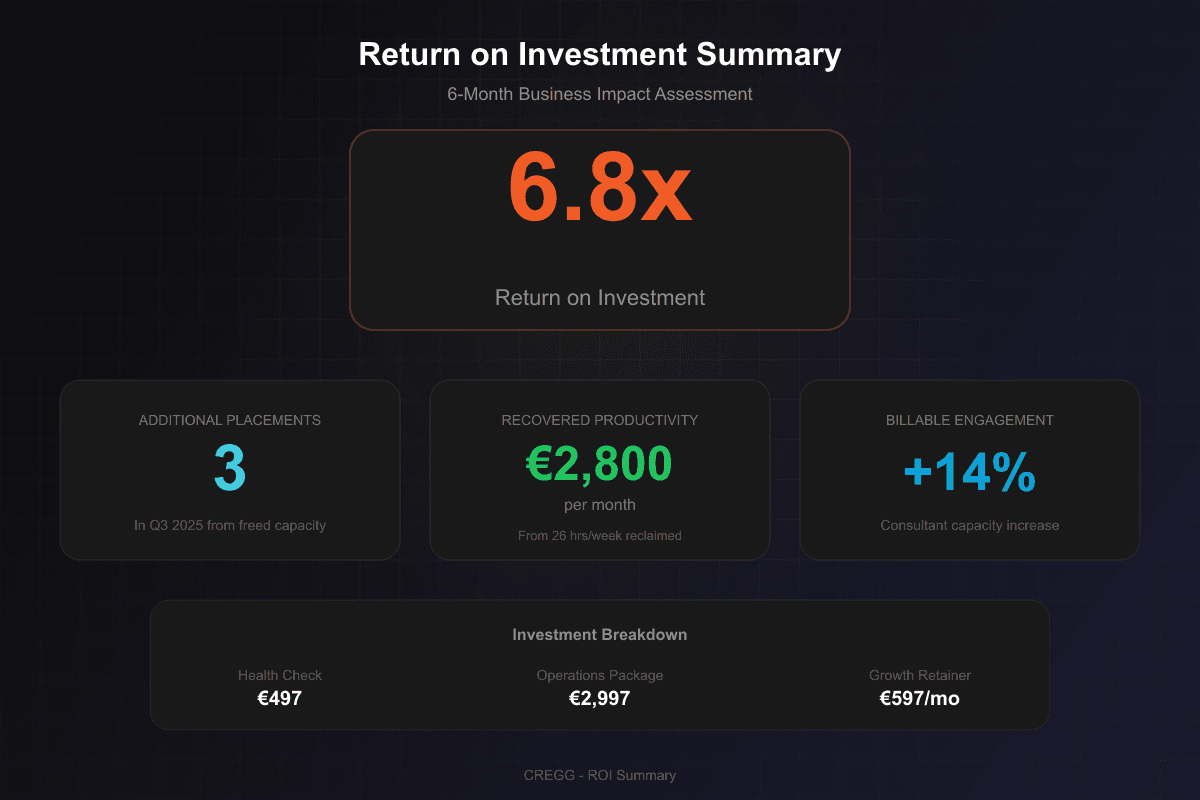
- Quantified the business cost of manual processes: 26+ hours of staff time lost per week and an 18% error rate on critical reports, translating to approximately 2,800 EUR/month in wasted productivity.
Step 2: Automation-Focused Digital Operations Package (2,997 EUR)
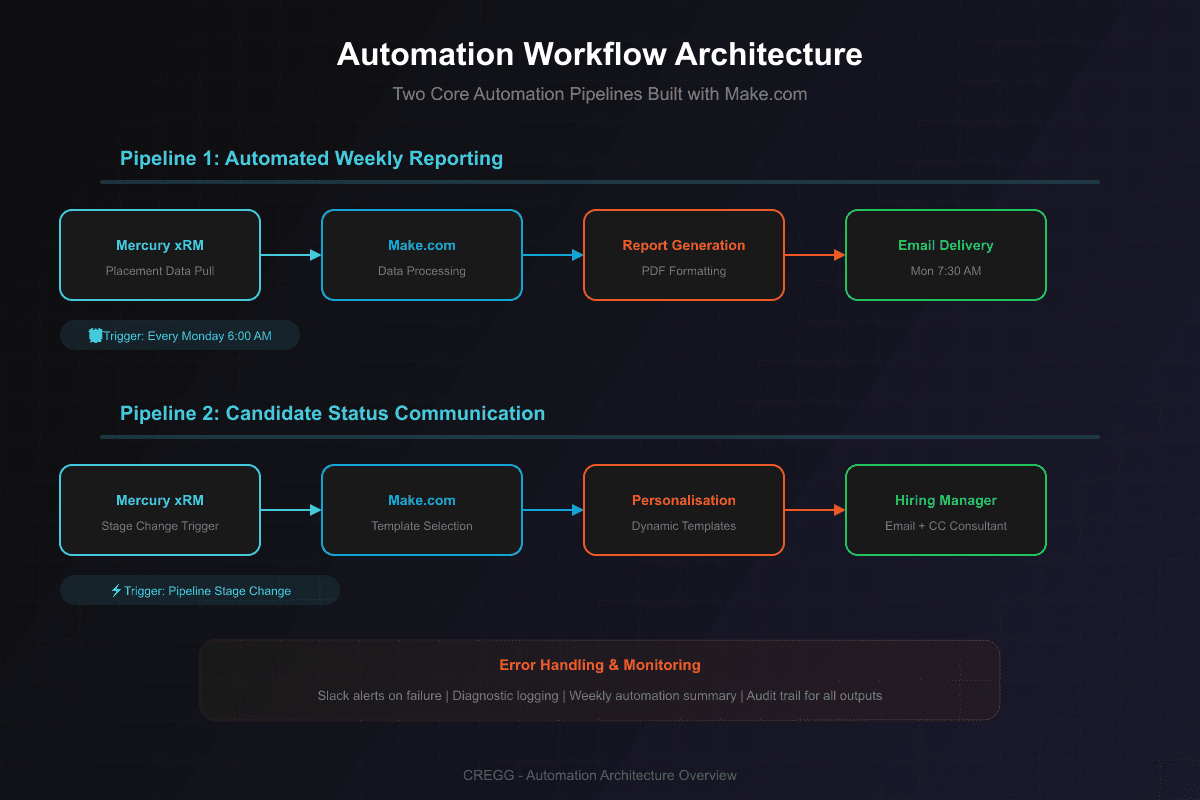
- Designed and built Automation 1: Automated Weekly Reporting Pipeline. A Make.com scenario that pulls placement data from Mercury xRM every Monday at 6:00 AM, cross-references client purchase orders, applies formatting templates, and delivers a completed report to the operations coordinator's inbox by 7:30 AM -- ready for review rather than compilation.
- Designed and built Automation 2: Candidate Status Communication Engine. A Make.com workflow triggered by Mercury xRM stage changes that automatically composes and sends templated (but personalised) status updates to the relevant hiring manager, with the consultant CC'd for visibility.
- Built error-handling and alerting into both automations: failed runs trigger Slack notifications to the operations coordinator with diagnostic information, and all automated outputs are logged for audit purposes.
- Created a shared documentation library with step-by-step guides for modifying templates, adding new clients to the reporting pipeline, and troubleshooting common issues -- ensuring CREGG is not dependent on NodeSparks for day-to-day adjustments.
- Delivered two structured training sessions (remote, 90 minutes each) for the operations coordinator and two senior consultants on managing and modifying the automation workflows.
Step 3: Growth Retainer (597 EUR/month)
- Monthly automation health checks: reviewing Make.com scenario logs, identifying failed or slow runs, and proactively adjusting workflows as Mercury xRM configurations evolve.
- Ongoing development of secondary automations: the retainer includes building 1-2 additional smaller automations per quarter based on CREGG's evolving operational priorities.
- Quarterly process review meetings to identify new automation opportunities as CREGG continues to scale, ensuring digital operations keep pace with business growth.
The Solution
- Automated Weekly Reporting Pipeline via Make.com: pulls Mercury xRM placement data, joins with client PO data from Google Sheets, applies conditional formatting and business logic, and delivers a polished PDF report by email every Monday at 7:30 AM.
- Candidate Status Communication Engine via Make.com: triggered by Mercury xRM pipeline stage changes, auto-generates personalised hiring manager updates using dynamic templates with candidate name, role, and next-step details.
- Mercury xRM API integration hardened with field-level validation, retry logic on failed API calls, and automatic handling of Mercury xRM schema changes to prevent silent automation failures.
- Slack-based alerting system for both automations: failed runs, data anomalies (e.g., placement without a matching PO), and weekly summary of all automated actions for the operations coordinator.
- Library of 8 communication templates for different candidate stages (submitted, interviewing, offered, placed, on-assignment, completed) designed with CREGG's tone of voice and branding.
- Complete operational playbook with workflow diagrams, template editing guides, troubleshooting decision trees, and Mercury xRM field mapping documentation.
- Real-time client KPI dashboard in Google Sheets, auto-populated via Make.com from Mercury xRM data, replacing the manually maintained version with live placement figures, fill rates, and time-to-hire metrics.
- Two 90-minute training sessions recorded and archived, plus a quick-reference guide for common tasks like adding a new client to the reporting pipeline or modifying a communication template.
Business and Technical Outcomes
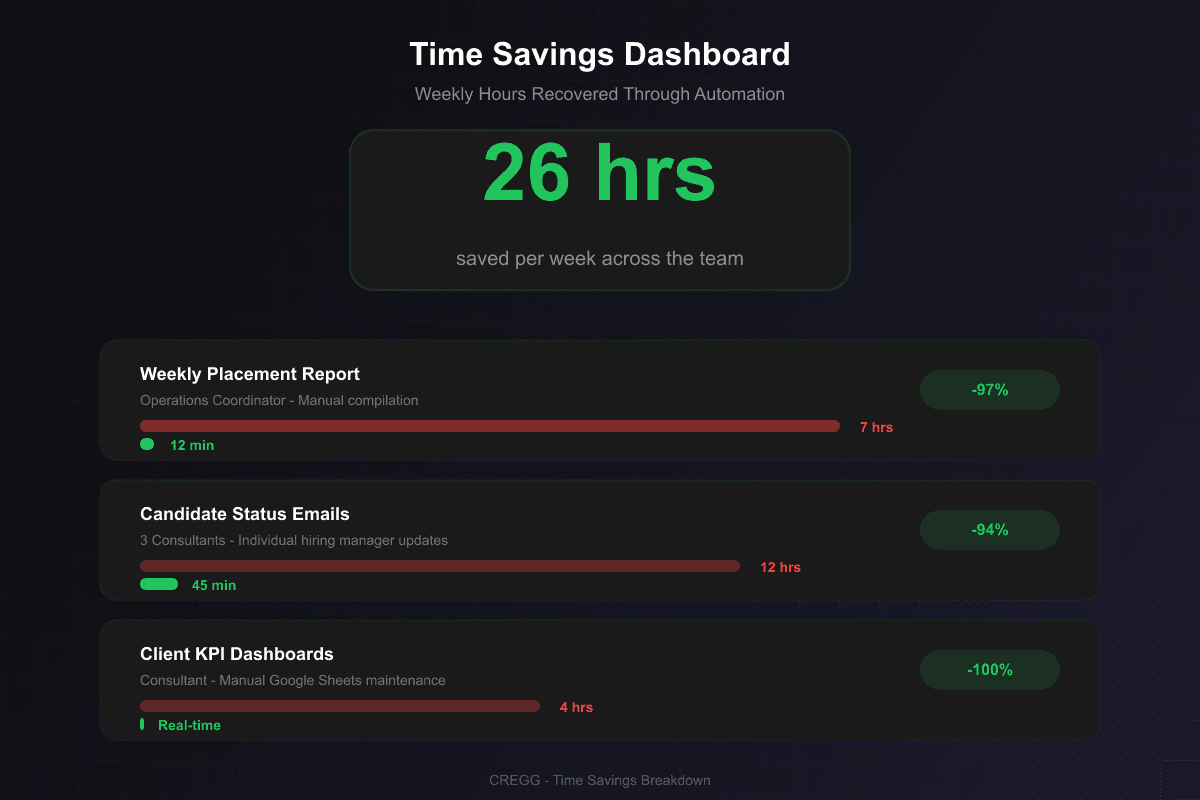
- Total time saved: 26 hours per week across the team, reallocated from manual administrative tasks to direct candidate engagement and client relationship management.
- Weekly placement report generation reduced from 7+ hours of manual work to 12 minutes of review time. The operations coordinator now reviews and approves the auto-generated report rather than building it from scratch.
- Report error rate dropped from 18% to 1.6% -- a 91% reduction. The two remaining error sources are edge cases involving mid-week client PO modifications, which are flagged automatically for manual review.
- Candidate status communication time cut from 12 hours/week (across 3 consultants) to under 45 minutes/week of template review. Hiring managers now receive updates within 4 minutes of a Mercury xRM stage change, compared to the previous 24-48 hour delay.
- Client KPI dashboards are now real-time rather than weekly snapshots. Three clients specifically cited the improved reporting responsiveness during quarterly business reviews.
- Consultant billable engagement time increased by an estimated 14% as administrative burden was reduced, contributing to 3 additional placements in Q3 2025 directly attributed to freed-up consultant capacity.
- 6.8x return on investment within 6 months when accounting for recovered staff time, reduced error-correction costs, and the revenue from additional placements enabled by freed consultant capacity.
The Impact
The most immediate change at CREGG was the Monday morning transformation. The operations coordinator, who had previously dreaded the start of each week knowing a 7-hour reporting marathon awaited, now arrives to find a completed, formatted report in her inbox. Her role shifted from data compiler to quality reviewer -- she scans the report for anomalies flagged by the automation, approves it, and has it distributed to stakeholders before 9:00 AM. The three consultants who were spending their mornings drafting individual hiring manager updates now find those communications already sent, allowing them to start their days with candidate calls and business development rather than administrative catch-up.
Six months into the engagement, the cultural impact was as significant as the operational one. CREGG's team had internalised a new way of thinking about their processes -- they began proactively identifying manual tasks that could be automated, rather than accepting inefficiency as inevitable. The quarterly review meetings became collaborative design sessions where consultants proposed workflow improvements based on their daily experience. The Growth Retainer delivered three additional smaller automations during this period: an automated reference check follow-up sequence, a contractor certification expiry alert system, and a monthly billing reconciliation check. Each built incrementally on the Mercury xRM integration infrastructure that was established in the initial project.
From a scalability perspective, the automations were designed to handle significantly more volume than CREGG currently processes. The reporting pipeline can accommodate up to 200 active placements per report (current average: 73), and the communication engine has been stress-tested at 3x current volume without performance degradation. This means that as CREGG continues to grow -- they are actively expanding their pharmaceutical and engineering verticals -- their operational infrastructure will not become a bottleneck again. The foundation is built to scale with them, not constrain them.
"To be fair, I was sceptical when we first discussed automating our reporting. We had tried something similar internally and it fell apart within two weeks. What made the difference with NodeSparks was that they actually understood how Mercury xRM works in a recruitment context -- they were not just connecting boxes in Make.com, they understood why a placement without a matching PO is a problem and built the logic to catch it. Honestly, getting my Monday mornings back has been life-changing. Our consultants are spending time on the phone with candidates now instead of writing status emails, and our clients have noticed the improvement in response times."- Sinead Brennan, Operations Coordinator, CREGG
We deploy engineering pods to architect the systems your product and operations need.